Popular Posts

New Posts

Showing posts with label AMD. Show all posts


AMD has expanded his offer with embedded solutions with new generation of APUs that are based on architecture called Jaguar. New APU's or SoC's has TDP which varies from 9 to 25 watts depending on the model, and they will replace existing embedded APU solutions from series G on market. The architecture of Jaguar is already used on chip that will power Playstation 4 and apparently new Xbox.
28-nanometer SoC's contain two to four Jaguar cores and Radeon HD graphics from 8000 series which is based on GCN architecture. There is also one channel DDR3 controller and communicational component including Four PCIe x1, one PCIe x4, 8 USB 2.0, 2  USB3.0, 2xSATA 6Gb/s, logic for access to SD cards and other interfaces.
The new generation APU's presents one step further in transition to HSA or Heterogeneous System Architecture. X86 and graphic cores in new APU's share L2 cache which speeds operations of GPUs. Of cores the emphasis here is not on the 3D performance, but the use of GPU for computation via OpenCL.  The idea is that this kind of energy-saving chip can still offer the high performance required for such analysis of real-time video. AMD is precisely in this context, is planning to establish themselves as competition ARM SoC's and Intel's Atom in SoC variants.
Specifically, AMD boasts that the new SoC's offer 113% better x86 performance compared to previous generation APU's or 125% better performance than the Intel Atom. When it comes to graphics, the new generation is 20% percent better than the old and 430% better than the graphics that boast Intel the same market segment.
 Finally, it is interesting that in a logo new generation G platform is a small letter "X". Since the AMD already announced Opteron-based ARM architecture, we are not at all surprised if in the near future on the market phenomena and AMD's SoC's that integrate Radeon graphics and ARM core.

AMD JAGUAR Coming soon!!!


AMD has expanded his offer with embedded solutions with new generation of APUs that are based on architecture called Jaguar. New APU's or SoC's has TDP which varies from 9 to 25 watts depending on the model, and they will replace existing embedded APU solutions from series G on market. The architecture of Jaguar is already used on chip that will power Playstation 4 and apparently new Xbox.
28-nanometer SoC's contain two to four Jaguar cores and Radeon HD graphics from 8000 series which is based on GCN architecture. There is also one channel DDR3 controller and communicational component including Four PCIe x1, one PCIe x4, 8 USB 2.0, 2  USB3.0, 2xSATA 6Gb/s, logic for access to SD cards and other interfaces.
The new generation APU's presents one step further in transition to HSA or Heterogeneous System Architecture. X86 and graphic cores in new APU's share L2 cache which speeds operations of GPUs. Of cores the emphasis here is not on the 3D performance, but the use of GPU for computation via OpenCL.  The idea is that this kind of energy-saving chip can still offer the high performance required for such analysis of real-time video. AMD is precisely in this context, is planning to establish themselves as competition ARM SoC's and Intel's Atom in SoC variants.
Specifically, AMD boasts that the new SoC's offer 113% better x86 performance compared to previous generation APU's or 125% better performance than the Intel Atom. When it comes to graphics, the new generation is 20% percent better than the old and 430% better than the graphics that boast Intel the same market segment.
 Finally, it is interesting that in a logo new generation G platform is a small letter "X". Since the AMD already announced Opteron-based ARM architecture, we are not at all surprised if in the near future on the market phenomena and AMD's SoC's that integrate Radeon graphics and ARM core.


As usual, just before the official launch of the new Radeon HD 7990, AMD's local partners were given the available marketing materials with photos, specifications and performance benchmark. Although the same documents should not be distribute on, such information is difficult to hide, and they often leaked to the public.

On photos that someone photographed from the monitor can see that AMD is not particularly reduced opportunities HD 7970 GPU to a new card with two of these GPUs have reduced power consumption. GPU’s on HD 7990 have clock speed at 1,000MHz compared to 1,050 in HD 7970. Standard GPU on older card is in fact 1,000 MHz and 1,050 MHz Boost clock. Therefore, if they are mentioned Boost clock, standard GPU's on the HD 7990 is actually 950 MHz.

Confusing at first glance, and theoretical performance. According to the table would suggest the HD 7990 has an unusually large texture fillrate compared to 7970th This is not true because if you multiply the clock speed of the chip with the number of units for texturing, it turns out that the value of 7970 GHz Edition was calculated incorrectly (it should be 134.4 GT / s). Same thing with pixel fillrates which should amount to 33.6, not 29.6 gigapixel per second.
 Probably the most interesting in the story is the performance chart showing the results of the tests 3DMark First Strike First Strike Extreme. This new two-headed Radeon overrides to Nvidia's Titanium, is currently the most powerful card based on a single GPU, and GeForce GTX 690, which also has two GPUs.
 The official presentation of the Radeon HD 7990 is being developed under the code name Malta has been confirmed for Wednesday.

AMD HD 7990 Specification Revealed!!!


As usual, just before the official launch of the new Radeon HD 7990, AMD's local partners were given the available marketing materials with photos, specifications and performance benchmark. Although the same documents should not be distribute on, such information is difficult to hide, and they often leaked to the public.

On photos that someone photographed from the monitor can see that AMD is not particularly reduced opportunities HD 7970 GPU to a new card with two of these GPUs have reduced power consumption. GPU’s on HD 7990 have clock speed at 1,000MHz compared to 1,050 in HD 7970. Standard GPU on older card is in fact 1,000 MHz and 1,050 MHz Boost clock. Therefore, if they are mentioned Boost clock, standard GPU's on the HD 7990 is actually 950 MHz.

Confusing at first glance, and theoretical performance. According to the table would suggest the HD 7990 has an unusually large texture fillrate compared to 7970th This is not true because if you multiply the clock speed of the chip with the number of units for texturing, it turns out that the value of 7970 GHz Edition was calculated incorrectly (it should be 134.4 GT / s). Same thing with pixel fillrates which should amount to 33.6, not 29.6 gigapixel per second.
 Probably the most interesting in the story is the performance chart showing the results of the tests 3DMark First Strike First Strike Extreme. This new two-headed Radeon overrides to Nvidia's Titanium, is currently the most powerful card based on a single GPU, and GeForce GTX 690, which also has two GPUs.
 The official presentation of the Radeon HD 7990 is being developed under the code name Malta has been confirmed for Wednesday.


Currently, the fastest supercomputer in the world called Cray Jaguar which is renamed to Titan after its upgrade with NVIDIA Tesla GPUs. The team from National laboratories in Oak Ridge has realized that this supercomputer with 18,688 Kepler based NVIDIA Tesla GPUs and AMDs Operation processors can be faster if the current system is upgraded with faster Data Storage System. This Data Storage System will be three times bigger and six times faster.

Current Data Storage System called Spider 2, and it’s a part from Lustra Data System for parallel saving. The system consists of 36 modules with capacity 1.12 PB and the total capacity is 40 PB of storage space. For this capacity there are 20,000 disks. The system bandwidth is 1TB/s, and current computer power is about 27 petaflops.
The current price of this supercomputer is about $104 million.

SUPERCOMPUTER CRAY JAGUAR GETS ANOTHER UPGRADE


Currently, the fastest supercomputer in the world called Cray Jaguar which is renamed to Titan after its upgrade with NVIDIA Tesla GPUs. The team from National laboratories in Oak Ridge has realized that this supercomputer with 18,688 Kepler based NVIDIA Tesla GPUs and AMDs Operation processors can be faster if the current system is upgraded with faster Data Storage System. This Data Storage System will be three times bigger and six times faster.

Current Data Storage System called Spider 2, and it’s a part from Lustra Data System for parallel saving. The system consists of 36 modules with capacity 1.12 PB and the total capacity is 40 PB of storage space. For this capacity there are 20,000 disks. The system bandwidth is 1TB/s, and current computer power is about 27 petaflops.
The current price of this supercomputer is about $104 million.


The new Microsoft gaming console Xbox will be based on x86 architecture. The new Xbox according to Bloomberb will be based on new AMD Jaguar processor just like upcoming PS4. The switch is a boon for AMD, which is also providing chips for Sony Corp. (6758)’s coming PlayStation 4, as it seeks a larger slice of the $67 billion global video-game market to help lessen its reliance on the shrinking PC industry. Microsoft also stands to benefit because game developers, who have moved toward making games for PCs and mobile devices, will find it easier to deliver those titles for the next Xbox.
AMD, based in Sunnyvale, California, rose 13 percent to $2.59 at the close in New York, the most since July 2011. That left the shares up 7.9 percent this year, reversing what had been a year-to-date decline. Microsoft slipped 0.4 percent to $28.59 and has climbed 7 percent in 2013.Microsoft, which had considered unveiling the Xbox 360’s successor this month, will do it later, three people said. The company is considering revealing plans for the new Xbox at the industry’s E3 expo in June or at a separate event in May or June, they said. Microsoft plans a May 21 event, The Verge reported today. The company hasn’t released the next Xbox’s specifications, including whether it will have an optical drive or details of online-game features and entertainment services. John Taylor, an AMD spokesman, declined to comment, as did David Dennis, a Microsoft spokesman.
Microsoft, based in Redmond, Washington, decided against an April event because it saw little competitive pressure from Sony, which plans to release the PlayStation 4 in time for the Christmas holidays, said two people.At Sony’s February unveiling of the PlayStation 4, the Tokyo-based company demonstrated the controller and game play running on prototype hardware, without showing the machine. Critics including Amir Anvarzadeh, a Singapore-based manager for Asia equity sales at BGC Partners Inc., panned the lack of any “revolutionary” advances and the PS4’s emphasis on social- gaming features.Nintendo Co. (7974)’s Wii U, another competitor, has been selling below the company’s initial forecasts since November. In January, the company said it expected to sell 4 million units in the year ending March 31, down from a previous outlook for 5.5 million.For AMD, providing chips for game consoles is part of Chief Executive Officer Rory Read’s plan to lessen the company’s dependence on the declining personal computer market. Read is aiming to get more than 20 percent of the AMD’s revenue from areas other than PCs by the fourth quarter.
Traditional console makers face competition from cheaper machines like Ouya Inc.’s, and changes in game play that favor inexpensive titles for mobile devices such as Apple Inc. (AAPL) iPads and Samsung’s Galaxy Tab.U.S. retail sales of packaged video games fell 21 percent last year to $8.9 billion, according to researcher NPD Group, while revenue from games downloaded to computers and mobile devices rose 16 percent to $5.9 billion. Globally, the market including hardware and accessories was $67 billion.
The decision to switch to mainstream PC processors also will make games developed on previous generation consoles incompatible with the new systems, Envisioneering’s Doherty said. Sony has said it hopes to deliver some older games over the Web, using its Gaikai cloud gaming service.
In addition to the main Power PC processor, the current Xbox 360 contains a graphics chip made by a unit of AMD. The PlayStation 3 uses a custom Cell processor and graphics chips from Nvidia Corp. (NVDA).
The x86 technology licensed by Intel Corp. (INTC) -- the so-called instruction set fundamental to all modern personal computers -- gives the new Xbox access to existing design elements, making the machine’s chip system cheaper to develop. The new also chips offer more computing power than parts Microsoft is currently using. Apple Inc. dropped the Power PC design from its Mac computers in 2005. In the PlayStation 4, Sony is adopting an AMD custom system-on-a-chip processor that includes eight 64-bit Jaguar cores with a Radeon graphics processor from AMD’s ATI unit. The PS4 will come with a secondary custom chip responsible for downloading and processing games in the background. At February’s unveiling, Sony lead system architect Mark Cerny said the PlayStation 4 will be a “supercharged PC architecture” with advanced memory and other features that will reduce development times by making some decisions within the hardware. According to Envisioneering’s Doherty, the switch will help Sony bring down the initial cost to make its machines. For big developers such as Electronic Arts Inc. (EA) and Activision Blizzard Inc. (ATVI), the savings will allow them to reduce their reliance on $60 titles as they compete with smaller publishers making games selling for $20 and less.
For more information about PS4 speculation please visit: 
Thank you for reading my blog. Please comment.

New XBOX similar to PS4 architecutre


The new Microsoft gaming console Xbox will be based on x86 architecture. The new Xbox according to Bloomberb will be based on new AMD Jaguar processor just like upcoming PS4. The switch is a boon for AMD, which is also providing chips for Sony Corp. (6758)’s coming PlayStation 4, as it seeks a larger slice of the $67 billion global video-game market to help lessen its reliance on the shrinking PC industry. Microsoft also stands to benefit because game developers, who have moved toward making games for PCs and mobile devices, will find it easier to deliver those titles for the next Xbox.
AMD, based in Sunnyvale, California, rose 13 percent to $2.59 at the close in New York, the most since July 2011. That left the shares up 7.9 percent this year, reversing what had been a year-to-date decline. Microsoft slipped 0.4 percent to $28.59 and has climbed 7 percent in 2013.Microsoft, which had considered unveiling the Xbox 360’s successor this month, will do it later, three people said. The company is considering revealing plans for the new Xbox at the industry’s E3 expo in June or at a separate event in May or June, they said. Microsoft plans a May 21 event, The Verge reported today. The company hasn’t released the next Xbox’s specifications, including whether it will have an optical drive or details of online-game features and entertainment services. John Taylor, an AMD spokesman, declined to comment, as did David Dennis, a Microsoft spokesman.
Microsoft, based in Redmond, Washington, decided against an April event because it saw little competitive pressure from Sony, which plans to release the PlayStation 4 in time for the Christmas holidays, said two people.At Sony’s February unveiling of the PlayStation 4, the Tokyo-based company demonstrated the controller and game play running on prototype hardware, without showing the machine. Critics including Amir Anvarzadeh, a Singapore-based manager for Asia equity sales at BGC Partners Inc., panned the lack of any “revolutionary” advances and the PS4’s emphasis on social- gaming features.Nintendo Co. (7974)’s Wii U, another competitor, has been selling below the company’s initial forecasts since November. In January, the company said it expected to sell 4 million units in the year ending March 31, down from a previous outlook for 5.5 million.For AMD, providing chips for game consoles is part of Chief Executive Officer Rory Read’s plan to lessen the company’s dependence on the declining personal computer market. Read is aiming to get more than 20 percent of the AMD’s revenue from areas other than PCs by the fourth quarter.
Traditional console makers face competition from cheaper machines like Ouya Inc.’s, and changes in game play that favor inexpensive titles for mobile devices such as Apple Inc. (AAPL) iPads and Samsung’s Galaxy Tab.U.S. retail sales of packaged video games fell 21 percent last year to $8.9 billion, according to researcher NPD Group, while revenue from games downloaded to computers and mobile devices rose 16 percent to $5.9 billion. Globally, the market including hardware and accessories was $67 billion.
The decision to switch to mainstream PC processors also will make games developed on previous generation consoles incompatible with the new systems, Envisioneering’s Doherty said. Sony has said it hopes to deliver some older games over the Web, using its Gaikai cloud gaming service.
In addition to the main Power PC processor, the current Xbox 360 contains a graphics chip made by a unit of AMD. The PlayStation 3 uses a custom Cell processor and graphics chips from Nvidia Corp. (NVDA).
The x86 technology licensed by Intel Corp. (INTC) -- the so-called instruction set fundamental to all modern personal computers -- gives the new Xbox access to existing design elements, making the machine’s chip system cheaper to develop. The new also chips offer more computing power than parts Microsoft is currently using. Apple Inc. dropped the Power PC design from its Mac computers in 2005. In the PlayStation 4, Sony is adopting an AMD custom system-on-a-chip processor that includes eight 64-bit Jaguar cores with a Radeon graphics processor from AMD’s ATI unit. The PS4 will come with a secondary custom chip responsible for downloading and processing games in the background. At February’s unveiling, Sony lead system architect Mark Cerny said the PlayStation 4 will be a “supercharged PC architecture” with advanced memory and other features that will reduce development times by making some decisions within the hardware. According to Envisioneering’s Doherty, the switch will help Sony bring down the initial cost to make its machines. For big developers such as Electronic Arts Inc. (EA) and Activision Blizzard Inc. (ATVI), the savings will allow them to reduce their reliance on $60 titles as they compete with smaller publishers making games selling for $20 and less.
For more information about PS4 speculation please visit: 
Thank you for reading my blog. Please comment.


At the first quarter of this year the Sony has revealed the hardware configuration of the PlayStation 4. Although Nvidia didn't want to participate in this project the PS4 will be equipped with AMD Radeon. (See: Nvidia said fuck you PS4). The processor of the PS4 is build according to SoC architecture, ie in a processor chip. These include 64-bit x86 AMD 8-core CPU, code-named Jaguar, AMD Radeon GPU and RAM memory consolidation GDDR5 8GB used for both GPU and the system.

According to what Sony announced, we will have PS4 with a 64-bit x86 CPU developed by AMD, CPU code-named Jaguar. AMD’s Vice President of global Communications and Industry Marketing John Taylor recently elaborated on the APU that is packed in Sony’s semi-announced PlayStation 4 console. At the most basic level, an APU is a single chip that combines general-purpose x86 central processing unit or CPU cores with a graphic processing unit (GPU) and a variety of system elements, including memory controllers, specialized vide decoders, display outputs etc. 

But before PlayStation 4 AMD leveraged the building blocks of its 2013 product roadmap for PCs and created a solution that incorporates the upcoming Jaguar CPU cores with next-generation Radeon graphics which will deliver 2 TFLOPS of compute performance. This will allow developers to fundamentally change the console gaming experience by letting them harness the power of parallel processing.
The accelerated processing unit or APU will consist of eight x64 AMD “Jaguar” cores and a next-generation Radeon GPU comprised of 18 compute units capable of cranking out 1.84 teraflops. The chip will be backed by 8GB of unified GDDR5 RAM which will give 17 GB/s of bandwidth, a built-in HDD, USB 3.0, BLU-ray optical drive, Gigabit Ethernet, Wireless N and more. Note that a Radeon HD 7970 is rated at 3.5 teraflops.

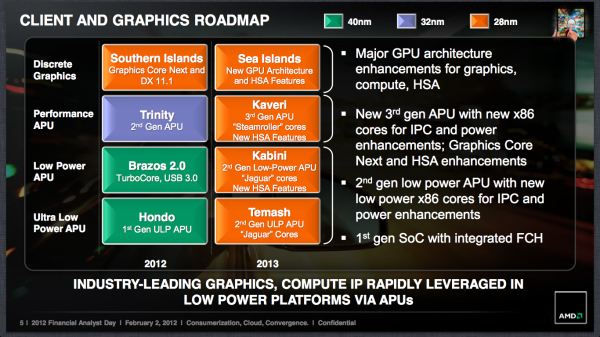
AMD's "Jaguar" is the successor to "Bobcat" which powers current C- and E-Series low-power APUs. The company is expected to launch its first batch of Jaguar-based APUs during the middle of 2013, codenamed as Kabini and Temash. These 28-nm chips will have power envelopes of 15W or less, and up to four cores. This is going to be a very exciting year for gamers, especially for those with AMD hardware in their PCs and consoles, as we have even more game-changing (pun intended) announcements still to come. 

PS4 configuration revealed


At the first quarter of this year the Sony has revealed the hardware configuration of the PlayStation 4. Although Nvidia didn't want to participate in this project the PS4 will be equipped with AMD Radeon. (See: Nvidia said fuck you PS4). The processor of the PS4 is build according to SoC architecture, ie in a processor chip. These include 64-bit x86 AMD 8-core CPU, code-named Jaguar, AMD Radeon GPU and RAM memory consolidation GDDR5 8GB used for both GPU and the system.

According to what Sony announced, we will have PS4 with a 64-bit x86 CPU developed by AMD, CPU code-named Jaguar. AMD’s Vice President of global Communications and Industry Marketing John Taylor recently elaborated on the APU that is packed in Sony’s semi-announced PlayStation 4 console. At the most basic level, an APU is a single chip that combines general-purpose x86 central processing unit or CPU cores with a graphic processing unit (GPU) and a variety of system elements, including memory controllers, specialized vide decoders, display outputs etc. 

But before PlayStation 4 AMD leveraged the building blocks of its 2013 product roadmap for PCs and created a solution that incorporates the upcoming Jaguar CPU cores with next-generation Radeon graphics which will deliver 2 TFLOPS of compute performance. This will allow developers to fundamentally change the console gaming experience by letting them harness the power of parallel processing.
The accelerated processing unit or APU will consist of eight x64 AMD “Jaguar” cores and a next-generation Radeon GPU comprised of 18 compute units capable of cranking out 1.84 teraflops. The chip will be backed by 8GB of unified GDDR5 RAM which will give 17 GB/s of bandwidth, a built-in HDD, USB 3.0, BLU-ray optical drive, Gigabit Ethernet, Wireless N and more. Note that a Radeon HD 7970 is rated at 3.5 teraflops.

AMD's "Jaguar" is the successor to "Bobcat" which powers current C- and E-Series low-power APUs. The company is expected to launch its first batch of Jaguar-based APUs during the middle of 2013, codenamed as Kabini and Temash. These 28-nm chips will have power envelopes of 15W or less, and up to four cores. This is going to be a very exciting year for gamers, especially for those with AMD hardware in their PCs and consoles, as we have even more game-changing (pun intended) announcements still to come.